

Plato’s Cave and the Limits of Our Reality
More than two thousand years before computers, virtual reality, or artificial intelligence, Plato described a problem that maps surprisingly well onto one of the central challenges of the Simulation Hypothesis: an observer inside a system may have no meaningful way to understand the complexity of the system outside it.
In Book VII of The Republic, Plato asks us to imagine people who have spent their entire lives confined inside a cave. They face a wall and see shadows produced by objects and a fire behind them. Because the shadows constitute everything they have ever observed, the prisoners naturally treat them as reality. When one prisoner is released, he discovers that the shadows were only representations of a much larger environment that had always existed beyond his field of perception.
Plato was not proposing that reality was a computer simulation. The Cave was an analogy concerned with knowledge, perception, and education. But the structure of his problem is remarkably useful when examining simulated reality: How much can an entity confined to one environment infer about the environment responsible for producing it?
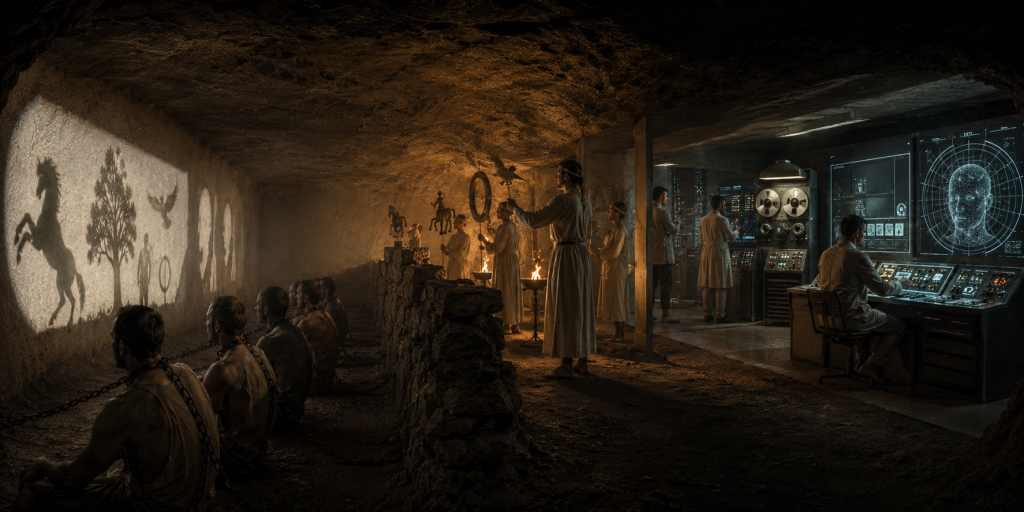
Computing Power Outside the Cave
One common objection to simulated-universe scenarios concerns computing power. Simulating enormous numbers of particles or an entire universe at microscopic resolution, would appear to require extraordinary computational resources.
That is a legitimate problem. Computation isn’t magic. Computers are physical systems constrained by energy, information capacity, thermodynamics, and the laws governing the universe in which they operate. Physicist Seth Lloyd has calculated theoretical physical limits on computation based on quantities including energy, quantum mechanics, relativity, and gravity. Experiments involving Landauer’s principle have likewise demonstrated a physical connection between information processing and thermodynamic cost.
But there is an important limitation to this objection:
Those calculations describe computation according to the physics we can observe.
If our observable universe were the cave, then we’re attempting to estimate the capabilities of whatever exists outside the cave using rules measured inside it. We currently have no empirical information about such an external reality or evidence that one actually exists.
Consequently, we cannot scientifically assign it a processor speed, available energy, physical dimensions, computational architecture, or even confidently assume that concepts such as “computer” and “processor” would adequately describe it.
That isn’t evidence for the Simulation Hypothesis. It’s a limitation on what computing-power arguments can establish about an entirely hypothetical external reality.
Bostrom’s Simulation Argument
Nick Bostrom’s influential 2003 Simulation Argument approaches the issue differently. His argument considers the possibility that technologically mature civilizations could possess enough computing power to run enormous numbers of detailed “ancestor simulations” containing observers with experiences like ours. His argument then examines the statistical consequences that would follow if civilizations actually produced large numbers of such simulations.
Importantly, Bostrom’s argument does not demonstrate that such computers exist or that we currently inhabit one. His conclusion is a three-part argument involving whether civilizations reach technological maturity, whether they choose to create large numbers of ancestor simulations, and whether observers like us would consequently be more likely to inhabit simulations.
But even that model makes assumptions about the relationship between our reality and a hypothetical parent reality. We don’t know that relationship.
The 8-Bit Comparison
Imagine a conscious character somehow existed inside an 8-bit video game. Everything available to that character would be governed by the capabilities and rules of its environment. Its world might contain a limited number of colors, simple sounds, two-dimensional movement, and relatively small amounts of information.
From inside that world, those limitations wouldn’t necessarily appear primitive. They would simply appear to be their laws of reality.
Now imagine trying to explain a modern 3D game to that character. Millions of colors. Photorealistic lighting. Huge environments. Dynamic physics. Online multiplayer. Artificial intelligence. Surround sound. Motion capture. Then explain that neither world represents the technological limit.
There are computers outside both of them, there are humans operating those computers, there are cities containing millions of those humans. There is an entire physical universe surrounding those cities. The 8-bit character wouldn’t simply be missing information about our world. It might lack the conceptual framework necessary to represent what our world is.
Mario cannot discover silicon by examining a brick. A character could hypothetically map every rule governing its environment without discovering the desk on which its computer sits.
Sources
Plato, Republic, Book VII, 514a–517c.
Read Plato’s Republic, Book VII — Perseus Digital Library
Nick Bostrom, “Are You Living in a Computer Simulation?”, The Philosophical Quarterly 53 (2003), 243–255.
Read Bostrom’s original paper
Seth Lloyd, “Ultimate Physical Limits to Computation,” Nature 406 (2000), 1047–1054.
Nature — Ultimate Physical Limits to Computation
Bérut et al., “Experimental Verification of Landauer’s Principle Linking Information and Thermodynamics,” Nature 483 (2012), 187–189.
Nature — Experimental Verification of Landauer’s Principle