

The Brain in a Vat hypothesis proposes a deceptively simple scenario: a human brain is removed from its body, kept biologically alive, and connected to a computer capable of supplying the same neural signals the brain would ordinarily receive from the eyes, ears, skin, and other sensory systems. If those signals were sufficiently accurate, the brain could experience an apparently physical world without that world actually surrounding it. From the brain’s perspective, walking down a street, drinking coffee, touching another person, or watching a sunset could feel completely real because the brain would still be receiving the neural activity associated with those experiences.
The modern version is most closely associated with philosopher Hilary Putnam, who examined the scenario in his 1981 book Reason, Truth and History, although it belongs to a much older tradition of skepticism about whether sensory experience gives us direct access to external reality. Putnam’s version imagines brains maintained in nutrient solution and connected to a computer that generates the electrical impulses ordinarily produced through interaction with the physical world. Importantly, Putnam was not arguing that humans actually are brains in vats. In fact, he developed a semantic argument intended to undermine the scenario.
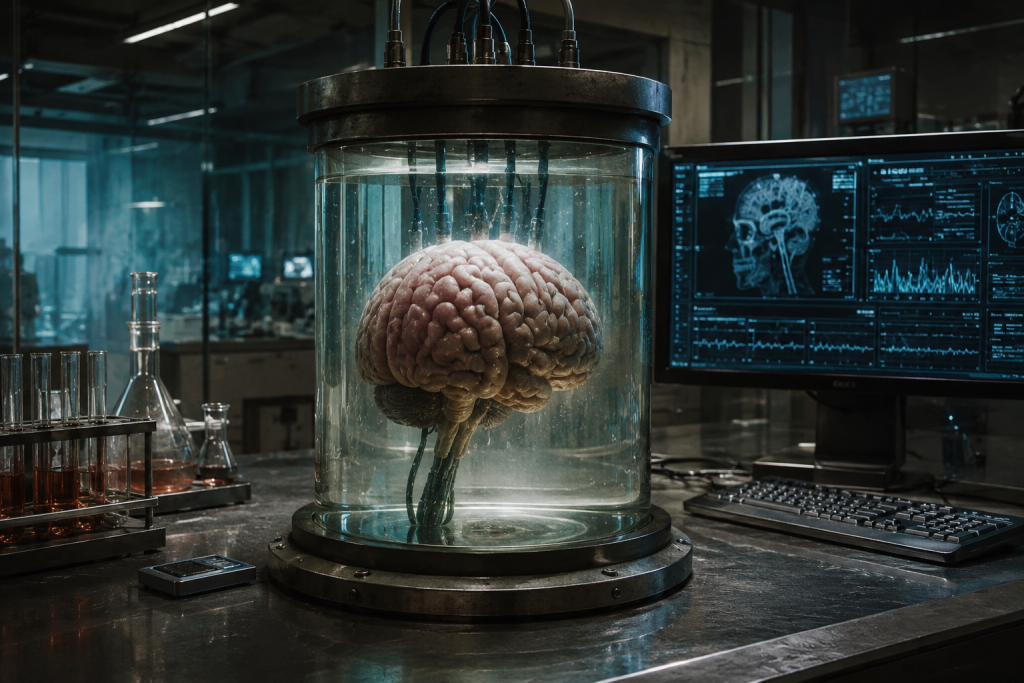
The Scientific Question Behind the Thought Experiment
What makes the idea relevant to simulation research is that perception already depends on information processing. The brain does not contain a miniature copy of the outside world. Sensory receptors convert events such as light, pressure, vibration, and chemical molecules into neural signals. The nervous system processes those signals, producing the perceptual experience through which we interact with our environment.
The Brain in a Vat hypothesis asks what would happen if the source of that information were replaced.
If an artificial system could reproduce the appropriate neural inputs, then the simulated environment would not necessarily need to reproduce every physical object surrounding the observer. It would need to reproduce the information reaching the observer. This distinction makes the Brain in a Vat fundamentally different from the idea of computationally simulating every particle in an entire universe.
The brain becomes the Interface.
Instead of constructing a physical sunset, a system would need to generate the neural information corresponding to seeing one. Instead of creating an actual cup of coffee, it would need to reproduce the visual, tactile, olfactory, thermal, and taste information associated with drinking it.
Whether a system could ever reproduce the totality of those signals convincingly is an enormous unresolved technical problem. But neuroscience increasingly demonstrates that biological neural systems can interact directly with machines, making the basic concept of exchanging information between neurons and computers an empirical field of research rather than purely science fiction.
Biological Computers Are Already Being Studied
There is an especially interesting development at the boundary between this thought experiment and modern biotechnology: brain organoids.
Researchers can grow three-dimensional collections of human neural cells in laboratories. These organoids are radically simpler than human brains and should not be confused with miniature conscious people. Researchers at Johns Hopkins and elsewhere have nevertheless proposed studying whether networks of human neurons could eventually perform forms of computation, a field sometimes described as organoid intelligence or biological computing.
That research effectively reverses the classic Brain in a Vat scenario.
Putnam imagined a biological brain connected to a computer that creates its environment. Researchers are now asking whether biological neural tissue itself could become part of a computing system.
Neither line of research demonstrates that consciousness can be uploaded, that organoids experience simulated worlds, or that our own reality is artificial. But it does weaken one intuitive boundary that once seemed obvious: biology and computing are not necessarily separate categories of information processing.
Could You Detect the Vat?
This is the central problem.
Suppose the simulated sensory information were perfect. Every experiment performed inside the environment would return the results expected from that environment. Every microscope, telescope, particle detector, computer, and measuring instrument would itself be represented through information delivered to the brain.
The observer could therefore develop an extraordinarily accurate science of the simulated environment without necessarily learning anything about the physical system producing it.
This is why the Brain in a Vat remains important to epistemology. The skeptical argument points out that if experiences generated artificially were indistinguishable from ordinary experiences, sensory experience alone could not straightforwardly distinguish the two situations.
Putnam attempted to attack the problem from another direction. His argument concerned reference: if a permanently envatted brain had never interacted with actual brains or actual vats, could its concepts of “brain” and “vat” genuinely refer to the external objects that we mean by those words? His proposed answer creates the strange possibility that a permanently envatted brain could not coherently assert, in our sense, I am a brain in a vat. The argument remains debated in philosophy.
From Brain in a Vat to Simulation Theory
The Brain in a Vat hypothesis and the Simulation Hypothesis are not identical. A simulated universe could contain completely simulated minds without any biological brain existing outside it. Conversely, an envatted biological brain could inhabit a digitally generated environment without the brain itself being simulated.
But they converge on the same scientific and epistemological problem:
How can an observer determine whether the information producing their experience originates from the reality they perceive?
A simulated person might look for computational artifacts in the universe. A Brain in a Vat faces an even harder problem because the instruments being used to conduct that search could themselves be part of the generated experience.
The hypothesis therefore does not provide evidence that our world is simulated. There is currently no empirical evidence establishing that humans are brains maintained outside their perceived bodies. Instead, it establishes a boundary on what observation alone can tell us.
We can investigate the rules of our observable environment with increasing precision. We can map the brain, measure neural signals, investigate consciousness, and develop interfaces between biological neurons and machines.
But every one of those discoveries occurs from inside the system available to us.
If there were another physical layer beneath our experience, the difficult question would not simply be whether that layer exists.
It would be whether our Interface gives us any way to observe it.
Sources
The Stanford Encyclopedia of Philosophy’s Brain in a Vat entry provides a detailed academic overview of the hypothesis and its relationship to skepticism. Putnam’s original discussion appears in Reason, Truth and History; Cambridge University Press’s overview of the chapter provides bibliographic information and an outline of his argument. For the emerging biological-computing research discussed above, Johns Hopkins University’s overview of organoid intelligence research provides a useful scientific introduction.